AAMRadar — Building the Tool That Reveals What Others Miss

Updated: Apr 30
Advanced Air Mobility is moving forward.
Interest is high. Policy is taking shape. Investment is happening.
Airports, communities, and industry partners are all looking to understand where AAM actually works—not just what’s possible, but where it fits, where it serves, and where it can be deployed in high-impact scenarios.
That’s the biggest hurdle—and often the biggest blind spot.
Because while activity is increasing across aircraft, infrastructure, and funding, how these pieces come together is still unclear.
Starting Point — The AAM Readiness Index Survey
In 2024, we launched the Airport AAM Readiness Index Survey to better understand how airports were engaging with AAM—and where they stood in relation to emerging opportunities.
The goal wasn’t to rank airports.
It was to establish a baseline.
To capture, in a structured way:
How airports were thinking about AAM
What infrastructure and planning considerations were in place
Where funding, partnerships, and operational awareness existed
And how those elements translated into levels of maturity and readiness
The Index was designed to bring clarity to a space that, at the time, was largely defined by high-level conversation and limited real-world context.
But as responses came in, something more important started to take shape.
What the Survey Revealed
Across participating airports, several consistent themes emerged:
Strong interest—but limited clarity on how to act.Airports are engaged and paying attention, but many are still unsure how to translate that interest into executable next steps.
A lack of defined pathways to participation.
Even where opportunities may exist, the connection between infrastructure, use cases, and partners is not always clear.
Resource and capacity constraints.
Planning, funding, and staffing limitations make it difficult to prioritize AAM without a clear, actionable path forward.
Fragmented signals across the industry.
Aircraft, infrastructure, policy, and funding are all advancing—but not always in ways that are easy to interpret or apply locally.
These weren’t isolated findings.
They were consistent.
And they pointed to a larger issue:
The gap isn’t just awareness. It’s alignment.
AAMRadar Takes Shape
Using these findings, we’re building the tool that identifies where AAM can actually be deployed—and why.
Not in theory.
Not in isolation.
But within the systems where it has the greatest potential to succeed.
AAMRadar takes the foundation established by the Index and expands it—bringing in additional layers of context to connect:
Airport readiness
Regional conditions
Infrastructure and operational environments
High-impact use case scenarios
Potential partnership pathways
The goal is simple: To provide clarity in a few clicks.
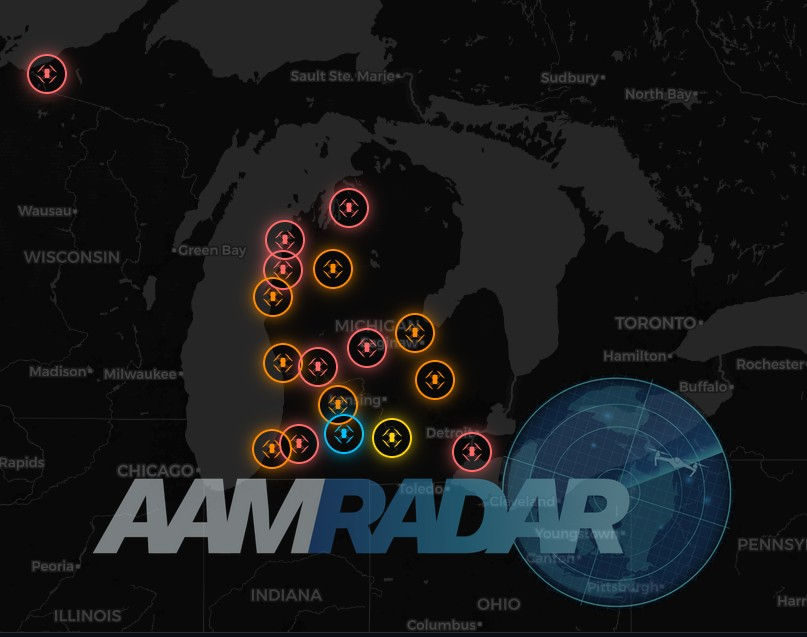
AAMRadar is structured as a geospatial, data-driven platform that brings together FAA and regional datasets, layered with AI-supported analysis to identify patterns, relationships, and opportunities.
It connects system-level signals—policy, funding, infrastructure—with ground-level realities—airport conditions, regional needs, and operational environments.
That connection is what’s been missing.
And it’s what turns activity into direction.
The output is not just data.
It’s defensible, decision-ready insight—built to:
Guide policy
Support funding and grant positioning
Streamline decision-making
Align stakeholders around real opportunities
The most important AAM opportunities don’t emerge from a single data point.
They emerge from how the system comes together.
Built Around a Single Focus
AAMRadar has a single focus:
Making AAM Real™
That means moving beyond demonstrations and testing to practical deployments—grounding AAM in real environments, real context, and real opportunities.
It means analyzing the complete system:
Existing infrastructure
Operational conditions
Community needs
Regional dynamics
And identifying where those elements align in a way that supports real-world deployment.
The Bottom Line
Momentum is building.
But alignment will be driven by reality. The next phase of AAM is not about proving what’s possible. It's about having a complete picture to understand what works—and how to move on it.
AAM will scale where it serves, where it integrates, and where it delivers real value.
AAMRadar is built to support that shift.
To connect systems, provide clarity and And ultimately —
Make AAM Real.
If you’re working to understand where AAM fits in your region, we can show you what this looks like in practice.



Comments