Why California Matters: Lessons from the Nation's Most Mature AAM Ecosystem

For communities exploring the future of Advanced Air Mobility (AAM), California offers something few other states can provide: a glimpse into what comes next.
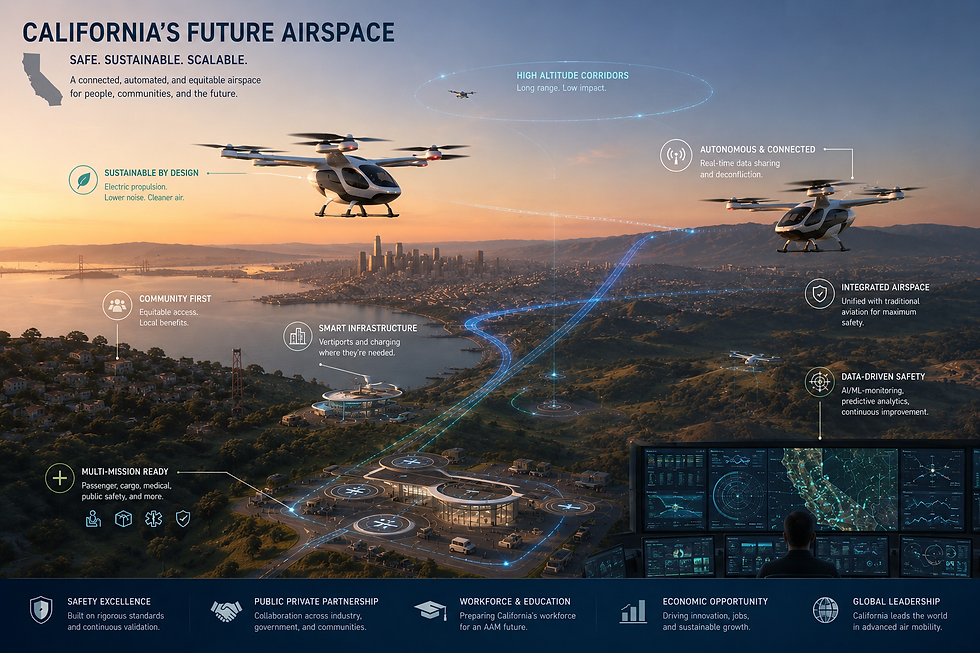
Widely regarded as the epicenter of modern U.S. Advanced Air Mobility development, California has become one of the nation's most important proving grounds for emerging aviation technologies, infrastructure planning strategies, public-private partnerships, and future deployment models.
That influence extends far beyond aviation.
California sits at the intersection of aerospace innovation, transportation planning, advanced manufacturing, climate policy, venture capital investment, research institutions, and technology development. The same ecosystem that helped fuel the rise of Silicon Valley has also helped create one of the world's most influential environments for Advanced Air Mobility.
Today, many of the industry's most recognizable organizations either call California home or maintain a significant presence within the state. Companies such as Joby Aviation, Archer Aviation, Wisk Aero, and Reliable Robotics have helped establish California as a center of gravity for next-generation aviation development. At the same time, airports, universities, transportation agencies, nonprofit organizations, and local governments continue exploring how emerging aviation technologies can be integrated into broader transportation systems.
This concentration of industry leaders, public-sector partners, and research institutions has made California one of the most closely watched AAM markets in the country. Recent federal initiatives, including the FAA's eVTOL Integration Pilot Program (eIPP), reflect many of the same questions California stakeholders have already been exploring: how future aviation systems integrate into existing transportation networks, how infrastructure investments should be evaluated, and how communities can balance innovation with broader public interests.
More Than Aircraft
One of the most important lessons emerging from California is that Advanced Air Mobility is no longer simply an aircraft conversation.
While aircraft development remains essential, successful deployment increasingly depends on a much broader network of stakeholders and planning considerations.
Infrastructure readiness, electrical capacity, transportation connectivity, emergency response coordination, land-use planning, workforce development, environmental policy, regulatory frameworks, and community engagement all play a role in determining whether future operations can succeed.
California has spent years exploring these questions.
As a result, many conversations throughout the state have evolved beyond discussions about vehicle performance and certification timelines. Increasingly, the focus is shifting toward implementation—understanding how future aviation systems can operate safely, responsibly, and effectively within existing communities.
This mirrors recommendations from organizations such as the American Planning Association, which has emphasized that Advanced Air Mobility planning must be integrated into broader conversations surrounding land use, transportation networks, infrastructure investment, environmental impacts, and community engagement.
The eIPP Effect
California's influence is also reflected in the broader national conversation surrounding Advanced Air Mobility.
The FAA's eVTOL Integration Pilot Program (eIPP) reflects a growing recognition that successful deployment depends on far more than aircraft certification. The program specifically emphasizes collaboration between airports, local governments, state agencies, infrastructure providers, and industry partners to evaluate how emerging aviation technologies can be integrated into real-world transportation systems.
Many of the same questions being explored through eIPP have already become active planning discussions throughout California.
How should future operations interact with existing transportation networks?
How should communities evaluate infrastructure investments?
What role should airports play?
How should public agencies balance innovation, economic opportunity, environmental stewardship, and community priorities?
California continues to serve as one of the nation's most active environments for exploring those questions.
A Complex Aviation Environment
California's significance is not simply a result of industry concentration.
It is also a result of complexity.
The state contains some of the busiest and most diverse aviation environments in the world. Dense metropolitan regions, major commercial airports, extensive general aviation activity, military operations, complex terrain, environmental constraints, and highly congested airspace create operational conditions unlike almost anywhere else in the United States.
That complexity creates challenges and opportunities.
If future aviation systems can successfully integrate into California's transportation and airspace environment, many stakeholders believe the lessons learned may help inform deployment strategies in markets across the country.
California has also become a leading arena for conversations surrounding environmental sustainability, air quality, noise mitigation, community acceptance, and equitable transportation planning. State and local planning efforts increasingly focus on balancing innovation with concerns surrounding environmental stewardship, quality of life, and long-term community impacts.
These conversations are particularly important because aviation in California rarely exists in isolation. Airports frequently operate adjacent to residential neighborhoods, business districts, environmental resources, and transportation corridors, creating a dynamic relationship between airport operations and community expectations.
Airports and Communities
Perhaps nowhere is California's complexity more visible than in the relationship between airports and the communities they serve.
Airports provide critical economic, transportation, emergency response, and connectivity benefits. At the same time, they often operate within densely populated regions where concerns surrounding noise, land use, environmental impacts, and future development remain active public concerns.
As Advanced Air Mobility continues to evolve, many of those same discussions are re-emerging through a new lens. Questions surrounding flight paths, noise profiles, vertiport locations, infrastructure investment, accessibility, environmental impacts, and community benefit will likely play a significant role in shaping future deployment decisions.
Researchers, planners, and public agencies increasingly view community engagement as a critical component of future deployment efforts rather than a secondary consideration. Public acceptance, noise management, environmental performance, and equitable access are rapidly becoming core planning discussions across the AAM ecosystem.
For Advanced Air Mobility to succeed, these conversations cannot occur after deployment decisions are made.
They must be part of the planning process from the beginning.
Why AAMRadar Is Going
As AAMRadar gears up for a week with some of the leading voices in AAM and airport operations in the state, one theme continues to emerge: The challenge is not a lack of technology, platforms, or systems. The challenge is creating a shared understanding of reality.
Whether the discussion involves Advanced Air Mobility, airport development, transportation planning, environmental impacts, community concerns, economic development opportunities, or emerging technologies, conversations can quickly become dominated by assumptions, speculation, competing narratives, and incomplete information.
That challenge is particularly visible in California, where aviation operates within one of the most complex transportation, environmental, regulatory, and community engagement environments in the country.
California doesn't need another AAM evangelist.
California needs a way to ground conversations in reality.
And California is not alone. Advanced Air Mobility will ultimately be most successful in communities that understand how to make it real—communities that can move beyond concepts and aspirations to informed, data-driven decision-making.
The purpose of AAMRadar™ is not to advocate for a particular outcome. Its purpose is to provide stakeholders with accessible, visual, data-informed information that supports better conversations and better decisions by identifying relationships among infrastructure, demographics, transportation networks, environmental conditions, and community characteristics that are often evaluated in isolation rather than as part of a larger system.
What infrastructure exists today?
What transportation assets already support a community?
What demographic, economic, environmental, and operational conditions are present?
Where are the opportunities?
Where are the constraints?
And perhaps most importantly, what does the data actually tell us?
In an era where conversations surrounding airports and aviation can quickly become polarized, the ability to access reliable information in a format that is visual, understandable, accessible, and—most importantly—helps tell a story may be just as valuable as any individual technology being discussed.
The goal is not simply to understand future aircraft.
The goal is to better understand how communities, airports, agencies, and industry leaders make decisions—and how better information can support better outcomes. Because before communities can decide where they want to go, they first need a clear understanding of where they are today.
Looking Beyond California
The objective is not to replicate California.
The objective is to learn from it.
As AAMRadar™ begins its national expansion, California provides an opportunity to study one of the country's most mature and dynamic aviation ecosystems and better understand where lessons can be adapted, where assumptions break down, and where communities across the country may face similar opportunities and challenges.
Because while every market is different, many of the questions remain remarkably similar.
How do communities prepare?
How do airports plan?
How do agencies coordinate?
How do transportation systems evolve?
And how do we ensure innovation remains connected to the people and communities it is ultimately intended to serve?
Those are the conversations shaping the future of aviation—and few places are exploring them more actively than California.



Comments